By Catherine Kavanaugh
STAFF REPORTER
Published: April 21, 2014 2:25 pm ET
Updated: April 21, 2014 2:30 pm ET
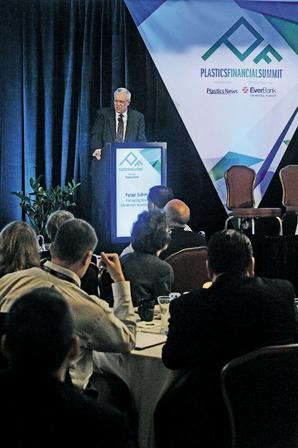
Image By: Michael Marcotte/Plastics News
Peter Schmitt, managing director at Montesino Associates LLC, speaks about film and sheet pricing at the Plastics Financial Summit.
CHICAGO — Savvy customers closely follow the prices of raw materials. The result: in the film and sheet segment of the plastics industry, even if processors could pass along every increase instantly, they would still face the challenge of low margins.
Customers tend to see the value of film and sheet as the value of the raw material, said Peter Schmitt, managing director at Montesino Associates LLC.
“If we look at the end user, the people buying our film, there’s little willingness to pay for the processing step,” Schmitt told attendees of thePlastics News Financial Summit on April 2. “The value is more and more perceived to be the raw material.”
Is this a zero-sum game?
It doesn’t have to be.
Schmitt recommends merging conversion steps for barrier layers that extend shelf life or guard against moisture, gas, oxygen and chemicals into mono-film processing when possible.
“You’re moving the value away from one material into your film,” Schmitt said. “It changes the fundamental economics.”
For example, PVC extruders can go from a margin of 25 cents per square foot to $3 with a laminating step. Sure, customers might complain the film now costs 10 times the price of PVC.
“But gosh, it’s got 40 times the barrier,” Schmitt said.
The extra step can take processors from captive-margin situations, which benefit only resin suppliers, to getting some margin back to the merchants.
Printing, coating and laminating are common processes to add value to film. So is percent of recycled content. And, wider use of intelligent films is on the horizon.
Smart films contain high-tech features like sensors that detect pathogens in food or radio frequency identification (RFID), which interfaces with a network to track products. RFID could usurp the universal product code one day and allow for checkout-free grocery shopping.
“In the next five years, it will be fascinating — bar codes, chips, RFID,” Schmitt said. “There’s going to be a huge demand for intelligent film and it’s a way for us to differentiate.”
Another way to free captive margins is to go on offense, according to Tom Langan, a consultant with WTL Trading Inc. who specializes in commodity-price sensitive businesses.
“Why leave yourself exposed to the marketplace?” he asked. “Sell it forward. I’m talking about strategies to implement in the next month and months out.”
Selling forward involves buying resin at a fixed price and selling a product at a fixed price. To address concerns about resin prices dropping, processors can also sell a put option that gives their customers downside-price protection.
“You determine what the premium is,”’ he said.
Processors also can buy a call option to protect themselves in case resin prices collapses. The option lets them lock in the lower cost.
“Get rid of the option you have and now you have a big, fat margin,” Langan said. “Options, in short, give you time. You don’t have to hold onto them. They are tradable, particularly in the futures market.”
While call options come at a price, the premium is only too much if you hold it, Langan added. He urges plastic processors to learn more about options and use them.
“You will love them and you won’t look back,” he said.
Langan argues that plastics processors will have no competition for this strategy.
“Anyone out there offering fixed-price deals forward, options insurance against the price? It’s great to have the playing field all to yourself for once,” he said.
To establish a program, executives need to write a margin management policy to formalize objectives and rules and then put an experienced risk manager in charge of it.
“Happy margins,” Langan said. “They will no longer be captive. You go get them.” |